
A New Troodos Multi-Actor Platform 1st Assembly
During the first Multi-Actor-Platform meeting, a bonding activity was carried out with 29 participants, including 22 stakeholders and 7 TAPE LINE project team members. More, specifically the rural development scientific team has took over the work of the territory field team of MountMet, which took place from May until July. The field team of MountMed has been working to develop the new network of people, able to govern a new form of territorial Living Lab. In the first Multi-Actor-Platform workshop held in Agros, 28th of September 2026, in cooperation with Department of Agriculture, 18 different actors contributed their professional and scientific views for the future sustainable organization and rearrangement of the Troodos Mountains’s goals. Troodos mountain range is often viewed through the lens of leisure—a scenic escape of cool forests and traditional stone villages. But beneath this picturesque surface, the region is a frontline in a battle against “cascading crises.” From the immediate pressures of climate change and soaring energy costs to the long-term threat of rural abandonment and food insecurity, the mountain is at a crossroads. The “TAPE L-I-N-E” project was initiated, launched and funded by the EU Agroecology Partnership. MountMed Scientific Field team, have collected the data from 90 detailed farmer questionnaires in correlation with social, environmental, ecological and economical aspects of their farm. The questionnaire has been adopted for EU members states contributing to the project and tailored made for each territory.
As Dr.Sofia Nikolaidou, researcher of MountMed Institute, states in her introductory presentation ‘In the Troodos mountains, a “Living Lab” is a space of possibility rather than a technical facility’.MountMed Institute has been previously meeting farmers across 10 traditional regions of Troodos mountains, Marathasa, Solea, Pitsilia, Krasochoria, Asinou Mountain Retreats, Mountainous Nicosia, Limassol and Larnaka regions, as well as, Koumandaria area, reaching 200 farmers and community members to develop an extended mosaic network of the mountainous people for the future of mountainous island regions. Furthermore, CIP’s research associate Dr. Gaki Dimitra states that ‘One of the most profound shifts in thinking within the Living Lab is viewing the mountain as a single, interconnected entity—an environmental hotspot’.The Troodos Living Lab consists a milestone that can render Troodos Mountains resilient for future generations. Nicolas Valanides, Agronomist and Agricultural Extension Unit and Researcher at MountMed Institute presents the Fact Reality Checks that are also the High Stakes of the Import Dependency: Cyprus currently imports 5 times the amount of fruit it produces. While vegetables see a 20% import rate, specific mountain staples like apples and pears make up 30-35% of fruit imports .
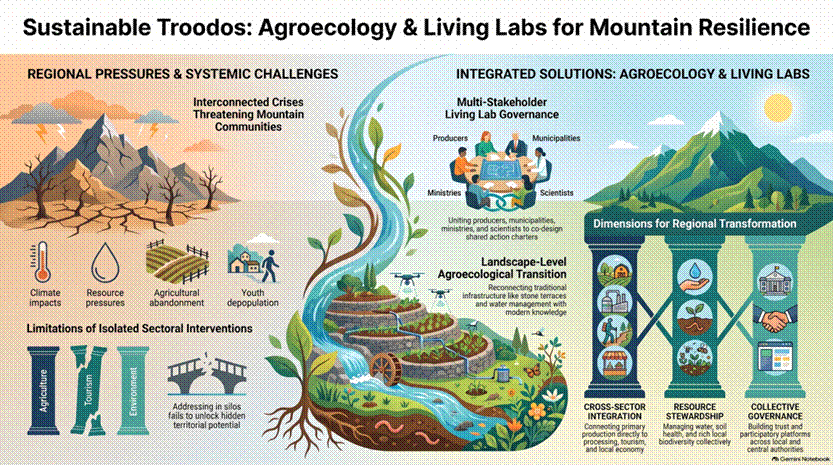
A Territorial Living Lab is not facility filled with microscopes and white coats, but rather a social and scientific interaction between all actors of the platform with a “territorial approach” designed to explore how mountain communities can survive an unpredictable future. Farmers find the project a radical idea, which aims to distill five critical lessons that could redefine our relationship with the land.
1. The “Living Lab” is People, Not Test Tubes
As Dr.Sofia Nikolaidou, researcher of MountMed Institute, states in her introductory presentation ‘In the Troodos mountains, a “Living Lab” is a space of possibility rather than a technical facility’. It moves away from “sectoral” thinking—where agriculture, tourism, and environment are treated as separate departments—toward what the lab calls a “Spherical Approach.” This model creates a forum where government officials, local authorities, scientists, and local producers collaborate as equals to uncover resources that remain invisible when sectors work in isolation. “Our goal here is not to provide ready-made answers, but to start a process of collaborative discovery. We are combining different types of knowledge to uncover the possibilities of the region that remain hidden when sectors work in isolation. “This isn’t theory; it is grounded in the lived experience of the community. By utilizing 90 stratified questionnaires to map current agroecological practices, the future living lab can suggest a more accurate transition towards Agroecology.
2. Agroecology is a “Landscape Lens,” Not Just a Field Guide
Furthermore, CIP’s research associate Dr. Gaki Dimitra states that ‘One of the most profound shifts in thinking within the Living Lab is viewing the mountain as a single, interconnected entity—an environmental hotspot’. Agroecology here is a “landscape lens” that recognizes that agriculture, tourism, and water management are inseparable. A central part of this identity is Agro-forestry , a characteristic Mediterranean synthesis where forests and food production coexist. To manage the mountain “spherically,” the Lab focuses on:
- Soil and Water: Rational management of the resources that sustain the entire island’s water supply.
- Agro-forestry and Cultural Identity: Maintaining the unique character of mountain products that link the plate to the landscape.
- Tourism and Local Economy: Leveraging the “mountain brand” to keep villages alive.
- Social Cohesion: Combating “demographic shrinkage” by making rural life economically viable for the youth.
3. Innovation as a “Return” to Ancient Wisdom
During the first assembly of the stakeholders confirm a startling argument: we aren’t “discovering the wheel.” Much of the innovation needed for modern climate resilience already exists in traditional knowledge. Practices such as dry stone walls (xerolithies ) and mountain terraces ( anavathmides ) are sophisticated environmental technologies protected and recognized by UNESCO . They manage water flow and prevent the soil erosion that leads to catastrophic flooding, while hosting beneficial macro and micro organisms. Furthermore, the 1st MAP meeting highlights grazing as a fire prevention tool —a traditional practice that modern science is now validating as a key strategy to protect abandoned landscapes from the annual threat of mega-fires. This is not a “romantic return to the past” but a strategic synthesis of archaic wisdom and modern climate science.
4. The Economic Paradox of “Less is More”
The most contentious debate in the Lab centers on the “Economic Paradox.” Intensive industrial farming seeks volume, but in a mountain environment, this model is collapsing under the weight of external costs and a sobering public health reality. Nicolas Valanides, Agronomist and Agricultural Extension Unit and Researcher at MountMed Institute presents the Fact Reality Checks that are also the High Stakes of the Status Quo
- Import Dependency: Cyprus currently imports 5 times the amount of fruit it produces. While vegetables see a 20% import rate, specific mountain staples like apples and pears make up 30-35% of fruit imports .
- The Health Cost: In a chilling moment during the workshop, participants noted that in certain high-intensity farming pockets, community cancer rates reportedly rose from 60% to 100% in a single year , a reality many link to heavy chemical use.
- The Apple Paradox: To be truly viable and cover the costs of sustainable production, organic mountain apples would need to be priced at €8/kg —as a figure of speech, currently out of reach for the average consumer.
- Water Volatility: Irrigation costs in Troodos mountains is nowadways a gamble Troodos mountains ranges from 40 cents to 80 cents per cubic meter. Agroecology proposes reducing external inputs (chemicals and energy) to increase net value. The challenge lies in moving the consumer’s “willingness to pay” away from cheap imports and toward the true cost of health and landscape preservation.
5. The “Invisible” Resource: Social Trust and Diaspora
The primary barrier to innovation in the Troodos isn’t a lack of technology, but a historical distrust between local producers and the central government. Farmers often feel that top-down policies fail to account for the unique hardships of mountain life.To bridge this, the potential Living Lab proposes “Cooperation Charters” —formalized, horizontal agreements where communities and agencies commit to shared goals.The future of a self organized Living Lab also identifies a massive, untapped resource: the Diaspora . These individuals, who have moved to cities or abroad, are more than just “market-makers.” They are potential investors who can bypass the lack of central funding to support local agroecological startups. Building a bridge back to these communities is the only way to reverse the demographic shrinkage that threatens to turn Troodos into a museum rather than a living landscape.
Conclusion: A New Blueprint for the Mediterranean
The Troodos example is more than a local project; it is a “prototype” for mountain regions across the Mediterranean. By integrating the technical rigor of 90 farmer questionnaires with a “spherical” policy vision, the Lab is building a roadmap for regional autonomy. The future of sustainable farming may not be found in a high-tech lab in a metropolitan center, but in the terraces and traditions of our highest peaks. It requires us to ask one final, vital question: Are we ready to develop the social trust culturally, to incorporate ancient and modern wisdom required to sustain the Mountain landscapes? Are we ready to develop a unified Mountainous brand that can feed the future generations of Troodos Mountains, balancing ecology, governance farming, livestock, tourism and Rural Life?